Conversion Intent Mapping for Affiliate Websites is one of the most powerful strategic frameworks for improving affiliate conversions without relying on aggressive sales tactics. Instead of forcing affiliate links into every article, intent mapping aligns your content with the reader’s stage in the decision process.
Advanced affiliate marketers understand that visitors arrive with different levels of awareness. Some are learning, some are comparing options, and some are ready to purchase. By structuring content to match these stages, your affiliate website becomes a guided decision system rather than a random collection of posts.
Within the Affiliate Marketing Lighthouse Framework, conversion intent mapping ensures that authority articles, guides, and review pages work together to guide readers naturally toward the right decisions.
Lighthouse Insight:
When content matches reader intent, affiliate recommendations feel helpful — not promotional.
What Is Conversion Intent Mapping for Affiliate Websites?
Conversion Intent Mapping for Affiliate Websites is the process of categorizing content based on the user’s decision stage. Each type of content serves a specific role in the conversion journey.
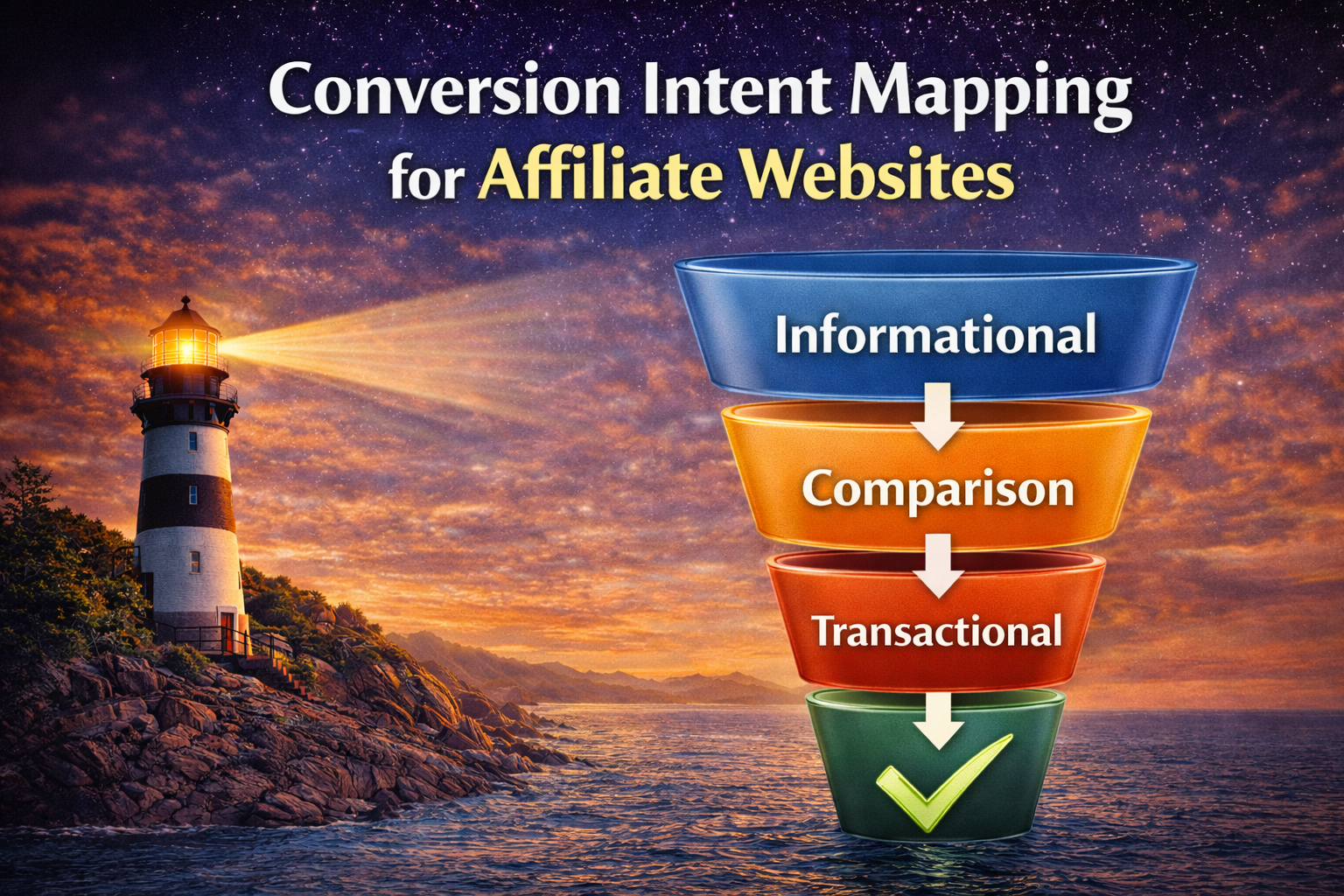
Most successful affiliate websites organize their content into three intent stages:
- Informational Intent – The reader is learning about a problem.
- Comparative Intent – The reader is evaluating solutions.
- Transactional Intent – The reader is ready to choose.
When content is mapped to these stages, readers move smoothly through your website rather than leaving to search elsewhere.
Stage 1: Informational Intent Content
At the informational stage, readers are not yet ready to buy. They are seeking clarity about a problem, strategy, or concept. This is where authority content becomes essential.
Articles such as Trust-Driven Affiliate Marketing build credibility and demonstrate expertise before any product recommendation appears.
Goals of informational content include:
- Educating readers about the topic
- Building trust and credibility
- Reducing confusion
- Preparing readers for evaluation
Affiliate links should be minimal at this stage. The focus should remain on education and clarity.
Stage 2: Comparative Intent Content
In the evaluation stage, readers begin comparing options. This is where buying guides, comparison articles, and feature breakdowns become powerful tools.
Comparative content bridges the gap between informational articles and review pages. For example, a buying guide can summarize evaluation criteria and introduce potential solutions without pushing a single product.
Strategic internal linking is critical here. As explained in Internal Linking Architecture for Affiliate Websites, authority posts should link naturally to comparison guides and review pages.
This structure allows readers to explore options without feeling pressured.
Stage 3: Transactional Intent Content
Transactional content targets readers who are close to making a decision. This includes detailed product reviews, product comparisons, and recommendation lists.
At this stage, affiliate links are appropriate because the reader is actively evaluating purchasing options.
However, trust signals remain essential. High-quality review pages should include:
- Balanced pros and cons
- Feature breakdowns
- Clear use cases
- Honest recommendations
Transparency increases reader confidence and improves long-term conversion rates.
Why Conversion Intent Mapping Improves Affiliate Conversions
Many affiliate websites struggle with conversions because they ignore user intent. Informational articles are overloaded with affiliate links, and review pages lack context.
Conversion Intent Mapping for Affiliate Websites solves this problem by aligning content structure with reader psychology.
Benefits include:
- Higher engagement metrics
- Improved reader trust
- More predictable conversion flow
- Better internal navigation
- Stronger SEO performance
Search engines increasingly reward helpful, intent-aligned content. These principles align with Google’s helpful content guidelines, which emphasize usefulness and experience over aggressive promotion.
How to Implement Conversion Intent Mapping
Implementing Conversion Intent Mapping for Affiliate Websites requires analyzing your current content structure and aligning each article with a specific purpose.
- Identify informational authority articles
- Create structured comparison guides
- Develop detailed review pages
- Strengthen internal linking pathways
- Reduce affiliate link density in early-stage content
When done correctly, this process transforms your website into a guided decision system where each page supports the next step.
Long-Term Impact on Affiliate Authority
Affiliate websites that implement conversion intent mapping experience stronger authority growth over time. Readers trust the content structure, return for future guidance, and explore multiple articles within the site.
This increases engagement signals, strengthens topical authority, and stabilizes rankings across multiple related keywords.
Ultimately, Conversion Intent Mapping for Affiliate Websites ensures that your content ecosystem supports both reader needs and sustainable affiliate revenue.
FAQ
What is Conversion Intent Mapping?
Conversion intent mapping is the process of structuring website content according to the user’s decision stage so that information, comparisons, and recommendations appear at the right moment.
How many intent stages should affiliate websites use?
Most affiliate websites perform best using three stages: informational, comparative, and transactional.
Does intent mapping affect SEO rankings?
Yes. When content aligns with search intent, engagement improves and search engines better understand the purpose of each page.
Return to the Homepage to continue strengthening your Affiliate Marketing Lighthouse authority ecosystem.