Affiliate Funnel Design for Authority Websites is fundamentally different from traditional aggressive sales funnels. Instead of pushing visitors toward rapid decisions, authority-driven affiliate funnels guide readers through clarity, education, comparison, and confident action.
Within the Affiliate Marketing Lighthouse Framework, a funnel is not a sales trap — it is a structured decision pathway.
Authority websites do not force conversions. They remove friction until conversion becomes the natural next step.
What Is Affiliate Funnel Design for Authority Websites?
Affiliate Funnel Design for Authority Websites refers to the structured organization of content that moves readers from awareness to action while preserving trust at every stage.
Unlike hype-driven funnels that rely on urgency, scarcity, or emotional pressure, authority funnels rely on:
- Information depth
- Structured internal linking
- Clear evaluation frameworks
- Transparent recommendations
- Intent-aligned content
As discussed in our article on Conversion Intent Mapping for Affiliate Websites, understanding intent stages is the foundation of funnel alignment.
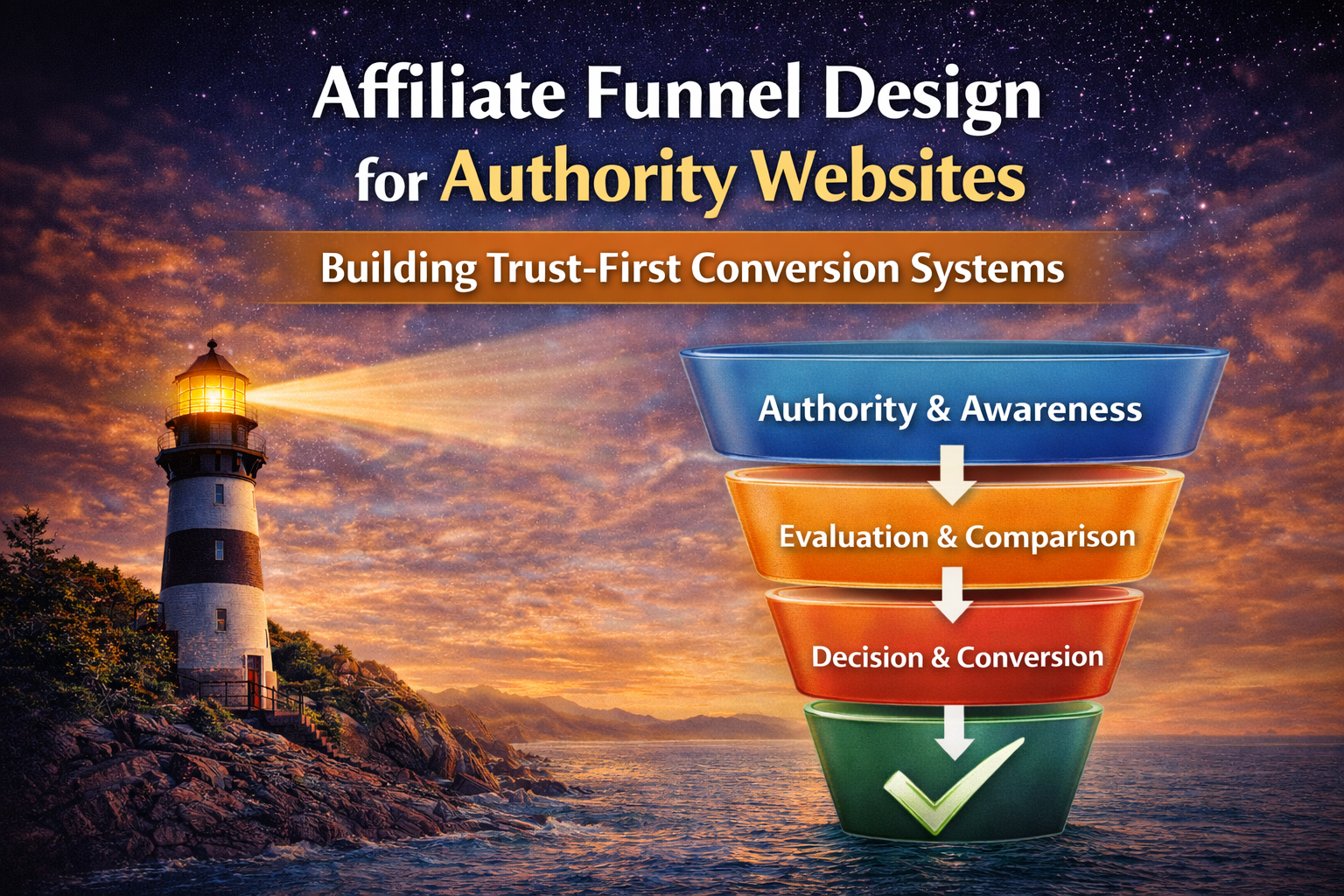
The Three Stages of an Authority-Based Affiliate Funnel
Stage 1: Authority & Awareness
At the top of the funnel, readers are seeking clarity. They are not ready to purchase — they are trying to understand.
Authority articles such as Trust-Driven Affiliate Marketing build credibility and define problems clearly.
Goals of this stage:
- Establish expertise
- Provide strategic insight
- Reduce confusion
- Build reader confidence
Affiliate links should be minimal and contextual.
Stage 2: Evaluation & Comparison
Once awareness is established, the reader enters evaluation mode. Buying guides and structured comparisons become essential.
Internal linking plays a critical role here. As explained in Internal Linking Architecture for Affiliate Websites, content must guide users naturally from authority posts to evaluation content.
This stage should:
- Compare options fairly
- Highlight strengths and weaknesses
- Clarify decision criteria
- Reduce uncertainty
Stage 3: Decision & Conversion
At the bottom of the funnel, readers are ready to decide. This is where detailed review pages, product breakdowns, and contextual affiliate links perform best.
However, the conversion only feels natural if trust has already been built. Authority-first funnel design ensures that recommendations feel earned, not inserted.
Structural Elements of Affiliate Funnel Design for Authority Websites
A strong funnel requires structural clarity:
- Pillar authority content
- Supporting cluster articles
- Strategic internal link pathways
- Clear category architecture
- Conversion-focused review pages
When these components connect properly, your website functions as a guided ecosystem rather than a disconnected collection of posts.
Why Authority Funnels Outperform Aggressive Funnels
Traditional affiliate funnels often rely on emotional triggers. Authority funnels rely on logical clarity and structured persuasion.
Benefits of Affiliate Funnel Design for Authority Websites:
- Higher trust retention
- Improved repeat visitor rates
- More stable search rankings
- Reduced algorithm volatility impact
- Long-term commission growth
Search engines increasingly reward helpful, experience-based content. These principles align with Google’s helpful content documentation, which emphasizes value and user satisfaction over promotional manipulation.
Common Affiliate Funnel Mistakes
- Overloading informational posts with affiliate links
- Skipping evaluation content entirely
- Relying solely on product reviews
- Ignoring internal link structure
- Publishing without intent mapping
Without structured funnel design, affiliate websites struggle with conversion consistency and authority growth.
Building Your Authority-Based Affiliate Funnel
To implement Affiliate Funnel Design for Authority Websites:
- Audit your content by intent stage
- Create or expand authority pillar posts
- Develop structured buying guides
- Improve review transparency
- Strengthen internal linking pathways
Consistency and structure are more powerful than volume. An authority funnel compounds over time.
Long-Term Impact of Structured Funnel Design
Affiliate marketers who implement structured funnel design build digital assets rather than short-term income streams.
Over time, authority strengthens brand recognition, improves engagement metrics, and stabilizes revenue performance.
Affiliate Funnel Design for Authority Websites is not about selling harder — it is about guiding better.
FAQ
How is an authority funnel different from a traditional sales funnel?
Authority funnels prioritize education, transparency, and structured guidance before introducing affiliate recommendations.
Does affiliate funnel design impact SEO?
Yes. Intent alignment, engagement metrics, and structured linking improve search engine understanding and ranking stability.
How long does it take to see results?
Most authority-based funnels begin showing measurable improvements within 3–6 months when supported by consistent publishing and internal linking.
Return to the Homepage to continue building your Affiliate Marketing Lighthouse authority ecosystem.