
Internal Linking Architecture for Affiliate Websites is one of the most overlooked yet powerful ranking factors in modern SEO. Advanced affiliate marketers who understand internal link structure build authority faster, distribute ranking power strategically, and create predictable conversion pathways.
Within the Affiliate Marketing Lighthouse Framework, internal linking is not random — it is structural. Every page supports another page in a deliberate authority chain.
Internal links are not navigation tools — they are authority signals.
Why Internal Linking Architecture Matters
Search engines interpret internal links as signals of importance, topical relevance, and structural hierarchy. When Internal Linking Architecture for Affiliate Websites is implemented correctly, it:
- Improves crawl efficiency
- Distributes link equity strategically
- Strengthens topical authority
- Reduces orphan pages
- Enhances user navigation
Without a structured linking model, even strong content can struggle to rank because search engines cannot clearly understand content relationships.
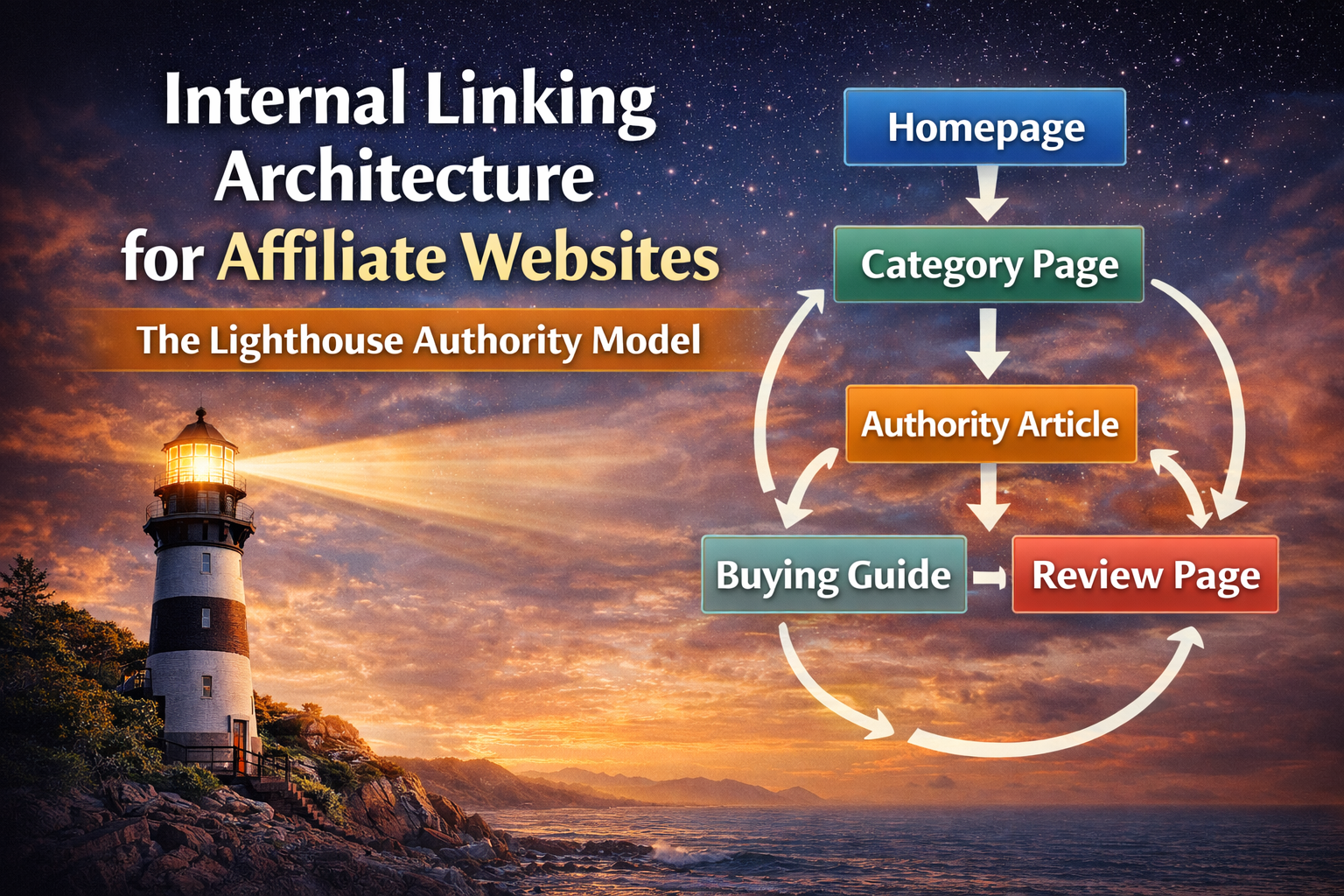
The Lighthouse Internal Linking Model
The Lighthouse model follows a deliberate hierarchy:
- Homepage
- Category Page
- Authority Article
- Buying Guide
- Review Page
- Return to Category
For example, an authority post such as Trust-Driven Affiliate Marketing should link downward to guides and reviews, while review pages link upward to category hubs.
This structure creates a closed authority loop that compounds ranking signals instead of scattering them.
Anchor Text Optimization Strategy
Internal Linking Architecture for Affiliate Websites must also consider anchor text distribution. Effective anchor text:
- Describes the destination clearly
- Uses partial keyword variations
- Avoids repetitive exact-match overuse
- Maintains contextual flow
Over-optimized anchor text can appear manipulative, while vague anchor text reduces topical clarity. Balance and variation are essential.
Topic Clusters and Silo Structure
Advanced affiliate sites use topic clusters. A central pillar article links to multiple supporting articles, which link back to the pillar. This creates a silo structure that strengthens topical authority.
You can explore additional authority-building concepts inside the Affiliate Marketing Strategy category, where structured clusters are implemented intentionally.
Search engines increasingly reward structured authority. These structural principles align with Google’s helpful content documentation, which emphasizes clarity, usefulness, and expertise.
Common Internal Linking Mistakes
- Excessive linking within short paragraphs
- Footer-wide link stuffing
- Orphaned content with no inbound links
- Linking to irrelevant pages for SEO manipulation
Internal Linking Architecture for Affiliate Websites should feel natural, logical, and helpful to readers — not engineered purely for ranking.
Long-Term Impact of Structured Internal Linking
When internal linking is treated as architecture rather than decoration, affiliate websites become easier to scale. New content fits into existing authority pathways instead of competing with older pages.
Over time, this produces stronger ranking stability, improved conversion flow, and clearer content hierarchy — all critical for advanced affiliate marketers building sustainable revenue systems.
FAQ
How many internal links should an affiliate post contain?
For a 1,200–1,500 word article, 4–8 contextual internal links are typically sufficient when placed strategically.
Does internal linking directly affect SEO rankings?
Yes. Internal links help search engines understand page importance, topical relationships, and crawl pathways.
Return to the Homepage to continue strengthening your Affiliate Marketing Lighthouse authority system.